Opportunity Solution Tree
Connect a business outcome to user opportunities, solutions and experiments.
Connecting research to what the team builds.
A tree from outcome to experiments.
Connect every idea to a customer need and a business outcome
The Opportunity Solution Tree was created by product coach Teresa Torres and explained in her book Continuous Discovery Habits (2021). It's a visual map with four levels: Outcome → Opportunities → Solutions → Assumption tests.
It stops teams from jumping straight from a goal to a feature. Every solution must connect to a real customer need, and every need to the outcome you're trying to move.
Four levels
Outcome
Opportunities
Solutions
Assumption tests
Building a tree, week by week
A fictional product trio (PM, designer, engineer) at a food delivery app, “Thali”.
Agree on the outcome
Interview every week
Map opportunities
Compare solutions
Test assumptions fast
Fictional example; numbers are illustrative.
Tree builder
Select a node, then add a child to it. The example tree is loaded to start.
Common mistakes
✓ Do
- Start with one clear, measurable outcome
- Write opportunities in the customer's words
- Break big opportunities into smaller ones
- Compare at least three solutions
- Test the riskiest assumption first
✗ Avoid
- Putting features in the opportunity row
- Outcomes that are really outputs (“launch X”)
- A tree built once and never updated
- Only one solution per opportunity
- Skipping assumption tests and building straight away
Opportunity Solution Tree in one screen
OUTCOME            one measurable result the team owns
  └ OPPORTUNITIES  customer needs, pains, desires (from interviews)
      └ SOLUTIONS  ≥3 ideas per target opportunity
          └ TESTS  small experiments on risky assumptions

HABITS  interview weekly · keep the tree visible · update it as you learn
ASSUMPTION TYPES desirability · viability · feasibility · usability · ethicsFigma template
A ready-made canvas for running this framework with your team. Free, editable, and it works in Figma and FigJam.
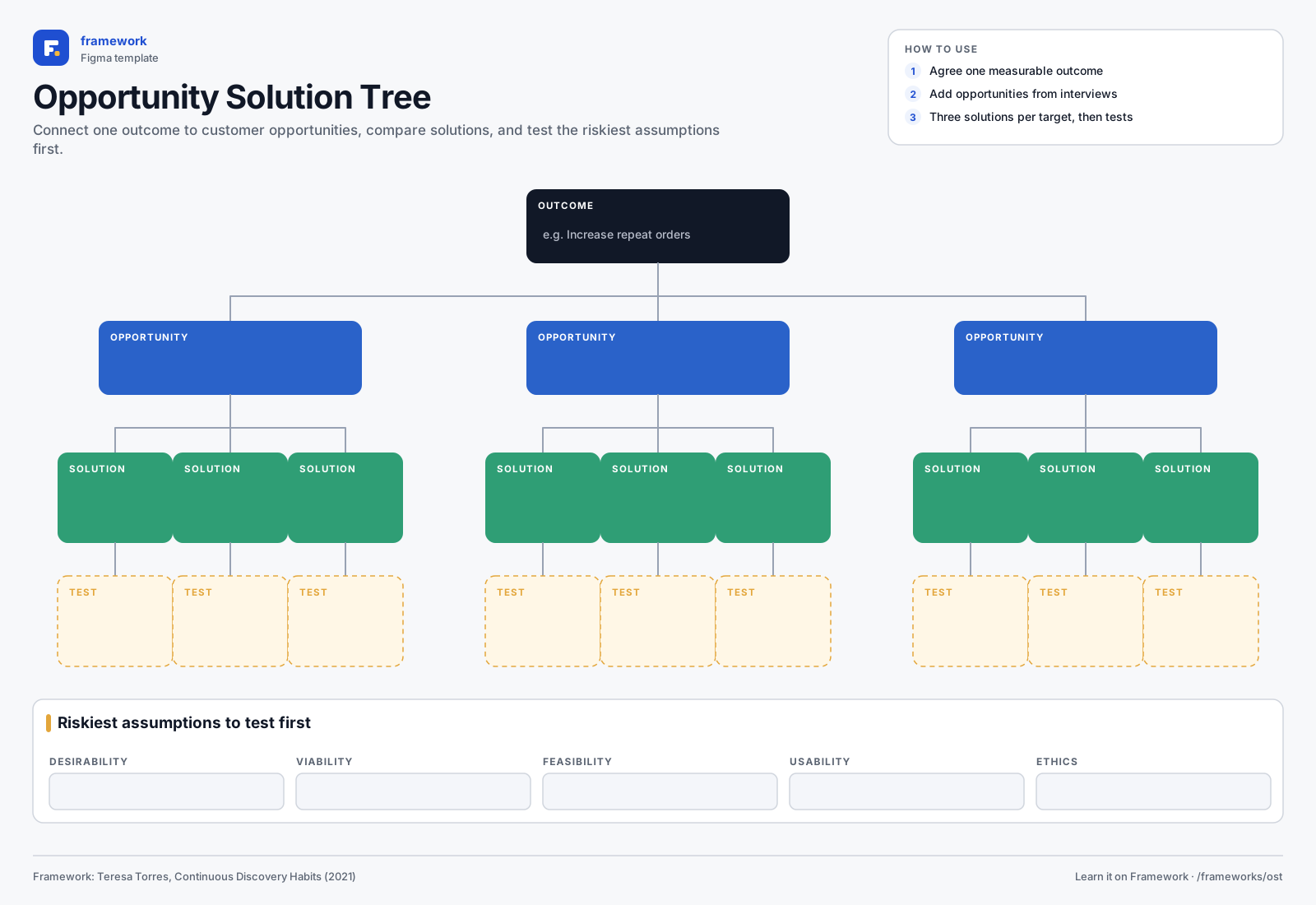
Opportunity Solution Tree
- Outcome → opportunities → solutions tree
- Riskiest assumptions
- 1Download the SVG, or copy it to your clipboard.
- 2In Figma or FigJam, drag the file onto the canvas — or paste with ⌘V / Ctrl V.
- 3Everything arrives as editable layers: type in the boxes, add stickies, duplicate rows.
Quick quiz
Get all three right to complete the lesson.
Notes are private and stored in this browser.
Sources and further reading
- Teresa Torres — Continuous Discovery Habits (2021)
- Product Talk — Opportunity Solution Trees
Related frameworks
MoSCoW
Must, Should, Could, Won't: a simple way to agree on scope.