Octalysis
8 core drives that explain why people do anything, and how products use them.
Making a product more engaging; auditing why people do or don't return.
An octagon score for a flow, with gaps and risks.
Every action has a motivation behind it
Octalysis is a gamification and behavioural design framework by Yu-kai Chou, explained in his book Actionable Gamification (2015). It says everything we do is driven by one or more of 8 core drives, placed around an octagon.
Games are designed around human motivation, while most products are designed around function: getting a task done efficiently. Chou calls the first approach human-focused design. If a product triggers none of the 8 drives, people have no reason to use it.
You don't need to turn your product into a game. Look at any screen and ask: which drive makes someone want to do this?
Quick test: why did you open this lesson? Curiosity is drive 7. Wanting to get better at design is drive 2.
“Users need to log their weight. Add a form with one field and a Save button.”
“Why would someone want to log their weight daily? Show progress to their goal (2), keep a streak (8), let them share a milestone (5).”
Tap any side of the octagon
Epic Meaning & Calling
“I'm part of something bigger than me.”
People act because they feel they're contributing to a mission, or were chosen to do something.
Mission and story, “beginner's luck”, contributing to a community, elite groups
Real example: Wikipedia editors write for free because they're building free knowledge for everyone.
All eight at a glance
Each card has the feeling it creates, the techniques that trigger it and a real product that uses it.
Epic Meaning & Calling
People act because they feel they're contributing to a mission, or were chosen to do something.
Techniques
Mission and story, “beginner's luck”, contributing to a community, elite groups
Development & Accomplishment
The drive to improve, master skills and overcome challenges. Points, badges and leaderboards live here — it's the most used and most overused drive.
Techniques
Progress bars, levels, XP, badges for real effort, clear win states
Empowerment of Creativity & Feedback
People enjoy experimenting, choosing their own strategy and seeing the result right away. This keeps chess fun without new content.
Techniques
Meaningful choices, tools to build or customise, instant feedback, unlockable options
Ownership & Possession
When people own something they want to improve, protect and collect more of it. Time invested creates ownership too.
Techniques
Virtual currency, collections, avatars, personalisation that learns you
Social Influence & Relatedness
Companionship, competition, mentorship and social proof. We're heavily shaped by what people around us do.
Techniques
Friends and teams, leaderboards, social proof, sharing and kudos
Scarcity & Impatience
We want things more when they're rare or we have to wait. Waiting keeps the product on our mind.
Techniques
Limited editions, countdowns, come back tomorrow, wait-or-pay
Unpredictability & Curiosity
Our brains fixate on the unknown. Surprise and random rewards keep people engaged — the same drive behind gambling.
Techniques
Mystery boxes, random rewards, easter eggs, cliffhangers
Loss & Avoidance
People work hard to avoid losing progress or missing out, often harder than they'd work to gain something new.
Techniques
Streaks, expiring points, progress that can be lost, FOMO
White hat vs. black hat, left brain vs. right brain
White hat vs. black hat
White hat (1, 2, 3) makes people feel powerful and fulfilled, but creates little urgency. Black hat (6, 7, 8) makes people act now, but too much of it feels manipulative. Drives 4 and 5 sit in between. Good products use both.
Left brain vs. right brain
Left brain (2, 4, 6) is extrinsic: you do it for the reward. Right brain (3, 5, 7) is intrinsic: the activity itself is fun. It's a metaphor, not neuroscience. When extrinsic rewards stop, people often stop too.
A Duolingo session, step by step
Follow one evening practice session and spot the drives at each step.
The evening nudge
The home screen
Inside the lesson
Lesson complete
The weekly league
The friends quest
Illustrative recreation for teaching. Not actual screenshots; names and numbers are made up and Duolingo's features change over time.
Score a product on the octagon
Load an example, or pick one flow in your own product and score how strongly it uses each drive (0–10). Example scores are illustrative.
Balanced hats. Urgency and good feelings are roughly even.
Leans left brain. Motivation depends on rewards. What happens when they stop?
Strongest: Development & Accomplishment, Loss & Avoidance. Weakest: Empowerment of Creativity & Feedback.
Motivation changes over the user journey
What gets someone to try a product is different from what keeps them for a year. Design each phase separately.
Discovery
Onboarding
Scaffolding
Endgame
Common mistakes
✓ Do
- Start from why the user would care, then choose techniques
- Pair black hat urgency with white hat reward, so acting feels good
- Design for each journey phase, not just day one
- Use real scarcity and real social proof only
- In payments and finance, lean on meaning and progress, and keep pressure gentle
✗ Avoid
- Adding points and badges to everything (“pointsification”)
- Retention built mostly on streak threats and countdowns
- Rewards that replace real value: users leave when rewards stop
- Fake timers, fake “only 2 left”, fake “500 people viewing”
- Guilt-trip notifications
Octalysis in one screen
8 CORE DRIVES (clockwise from top)
1 Epic Meaning & Calling ......... bigger purpose        WHITE HAT
2 Development & Accomplishment ... progress, mastery     WHITE HAT · LEFT
3 Empowerment of Creativity ...... choice + feedback     WHITE HAT · RIGHT
4 Ownership & Possession ......... collect, customise    LEFT
5 Social Influence & Relatedness . compare, belong       RIGHT
6 Scarcity & Impatience .......... limited, wait         BLACK HAT · LEFT
7 Unpredictability & Curiosity ... surprise, mystery     BLACK HAT · RIGHT
8 Loss & Avoidance ............... streaks, FOMO         BLACK HAT

AUDIT IN 5 STEPS
1. Pick one target action
2. List every motivating element in the flow
3. Tag each element with drive numbers
4. Score each drive 0–10 and plot the shape
5. Fix gaps; rebalance heavy black hat

JOURNEY: Discovery → Onboarding → Scaffolding → Endgame
Figma template
A ready-made canvas for running this framework with your team. Free, editable, and it works in Figma and FigJam.
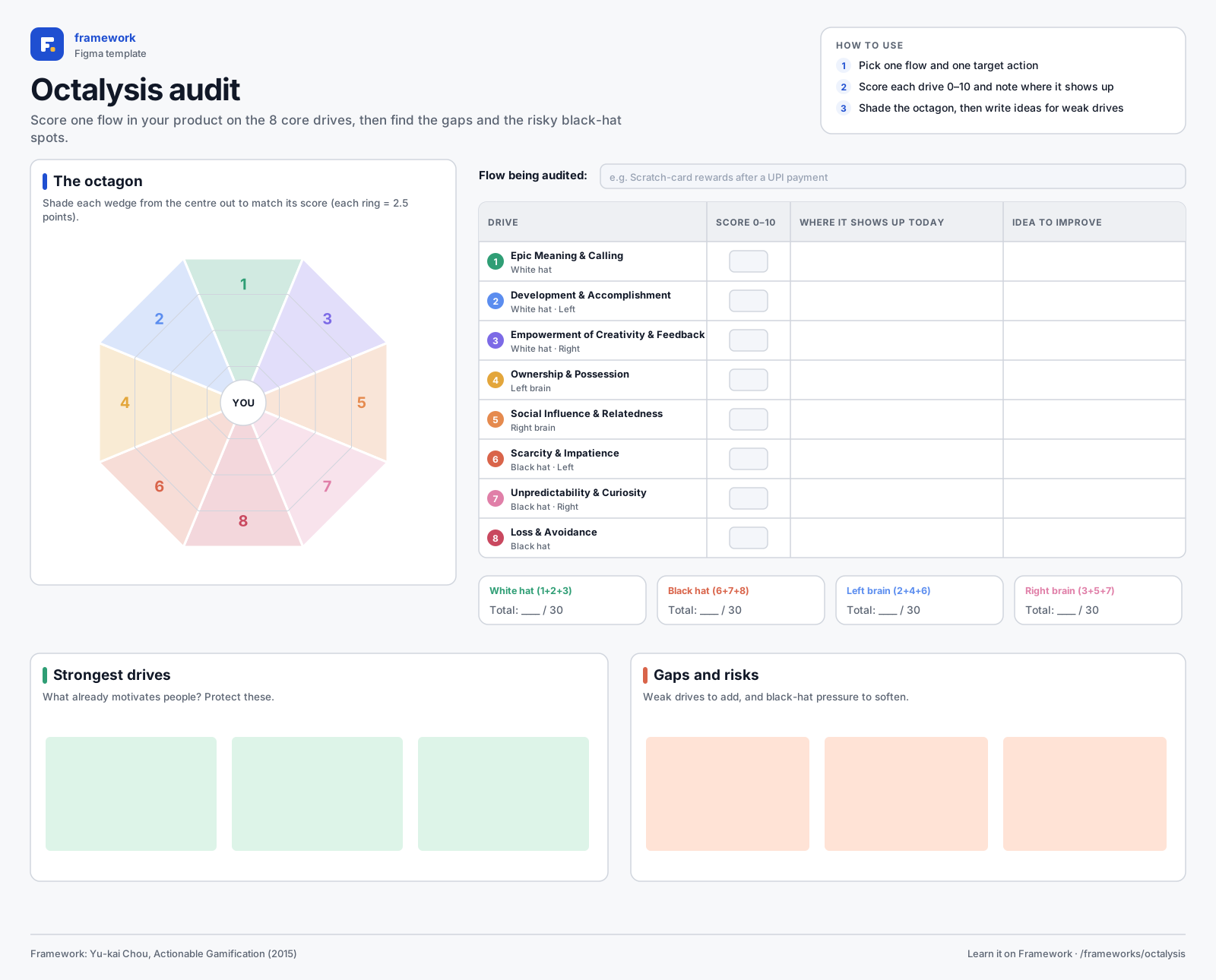
Octalysis audit
- Scoring octagon
- 8-drive score table
- Hat & brain totals
- Strengths and risks
- 1Download the SVG, or copy it to your clipboard.
- 2In Figma or FigJam, drag the file onto the canvas — or paste with ⌘V / Ctrl V.
- 3Everything arrives as editable layers: type in the boxes, add stickies, duplicate rows.
Quick quiz
Get all three right to complete the lesson.
Notes are private and stored in this browser.
Sources and further reading
- Yu-kai Chou — Actionable Gamification: Beyond Points, Badges, and Leaderboards (2015)
- Octalysis framework overview — yukaichou.com
Related frameworks
Fogg Behavior Model
Behaviour happens when Motivation, Ability and a Prompt meet at the same moment.