Double Diamond
Discover, Define, Develop, Deliver: explore the problem before you solve it.
Planning a project from a vague brief to a shipped solution.
A problem statement, How-might-we questions and a phase plan.
Design the right thing, then design the thing right
The Double Diamond was developed by the UK's Design Council in 2004, based on its research into how designers actually work. It shows the design process as two diamonds.
The first diamond is about the problem: go wide to understand it (Discover), then narrow down to one clear problem (Define). The second diamond is about the solution: go wide with ideas (Develop), then narrow down to what works (Deliver).
The shape shows the key habit: diverge, then converge — twice.
Tap a phase
Each half of a diamond is a phase. See what you do there, which methods to use, and how you know you're done.
Discover
What's really going on?
Understand the problem from the user's side, without jumping to solutions.
- User interviews
- Observation / contextual inquiry
- Analytics and support tickets
- Stakeholder interviews
- Competitor review
- Diary studies
Research notes, quotes, data and early insights.
You're done whenYou keep hearing the same things from new users (saturation).
Cutting order cancellations at a food delivery app
A fictional team at “Thali”, a food delivery app, walks through both diamonds.
The brief arrives
Discover: talk to customers
Define: one clear problem
Develop: many ideas
Deliver: test and ship
Loop back
Fictional worked example for teaching. Thali is not a real company, and the research findings and numbers are illustrative.
“How might we” generator
The bridge between Define and Develop. Describe your problem and get several ways to frame it. Good HMWs are not too broad and not too narrow.
Pick the one or two that make your team go “ooh”. Those are good starting points for brainstorming.
- 1 · Direct
How might we help customers waiting for a late order know when their food will really arrive?
- 2 · Remove the barrier
How might we take away an ETA that goes silent after checkout for customers waiting for a late order?
- 3 · Question the assumption
How might we help customers waiting for a late order know when their food will really arrive without an ETA that goes silent after checkout?
- 4 · Make it effortless
How might we make it effortless for customers waiting for a late order to know when their food will really arrive?
- 5 · Flip it
How might we make an ETA that goes silent after checkout something customers waiting for a late order never have to think about?
- 6 · Borrow an idea
How might a hotel concierge help customers waiting for a late order know when their food will really arrive?
Four principles
In 2019 the Design Council updated the model into a wider “Framework for Innovation” with four principles.
Put people first
Communicate visually and inclusively
Collaborate and co-create
Iterate, iterate, iterate
Common mistakes
✓ Do
- Treat the brief as a hypothesis to check, not an order
- Time-box each phase so research doesn't go on forever
- Write down the problem statement and get agreement
- Loop back when testing reveals something new
- Make it visible: research walls, maps, sketches
✗ Avoid
- Skipping the first diamond (“solutionising”)
- Treating it as a strict waterfall
- Converging too early, with only one idea
- Research that never changes the design
- Shipping and never measuring
Double Diamond in one screen
   PROBLEM SPACE              SOLUTION SPACE
   <> Discover  > Define      <> Develop   > Deliver
   diverge       converge     diverge      converge

DISCOVER  What's really going on?        interviews, observation, data
DEFINE    Which problem do we solve?     affinity map, personas, problem statement, HMW
DEVELOP   What could the solutions be?   brainstorm, Crazy 8s, low-fi prototypes
DELIVER   Which works? Ship it.          usability tests, A/B tests, handoff, measure

PRINCIPLES  people first · communicate visually · co-create · iterate
HMW FORMULA  How might we help [user] [goal] without [barrier]?
Figma template
A ready-made canvas for running this framework with your team. Free, editable, and it works in Figma and FigJam.
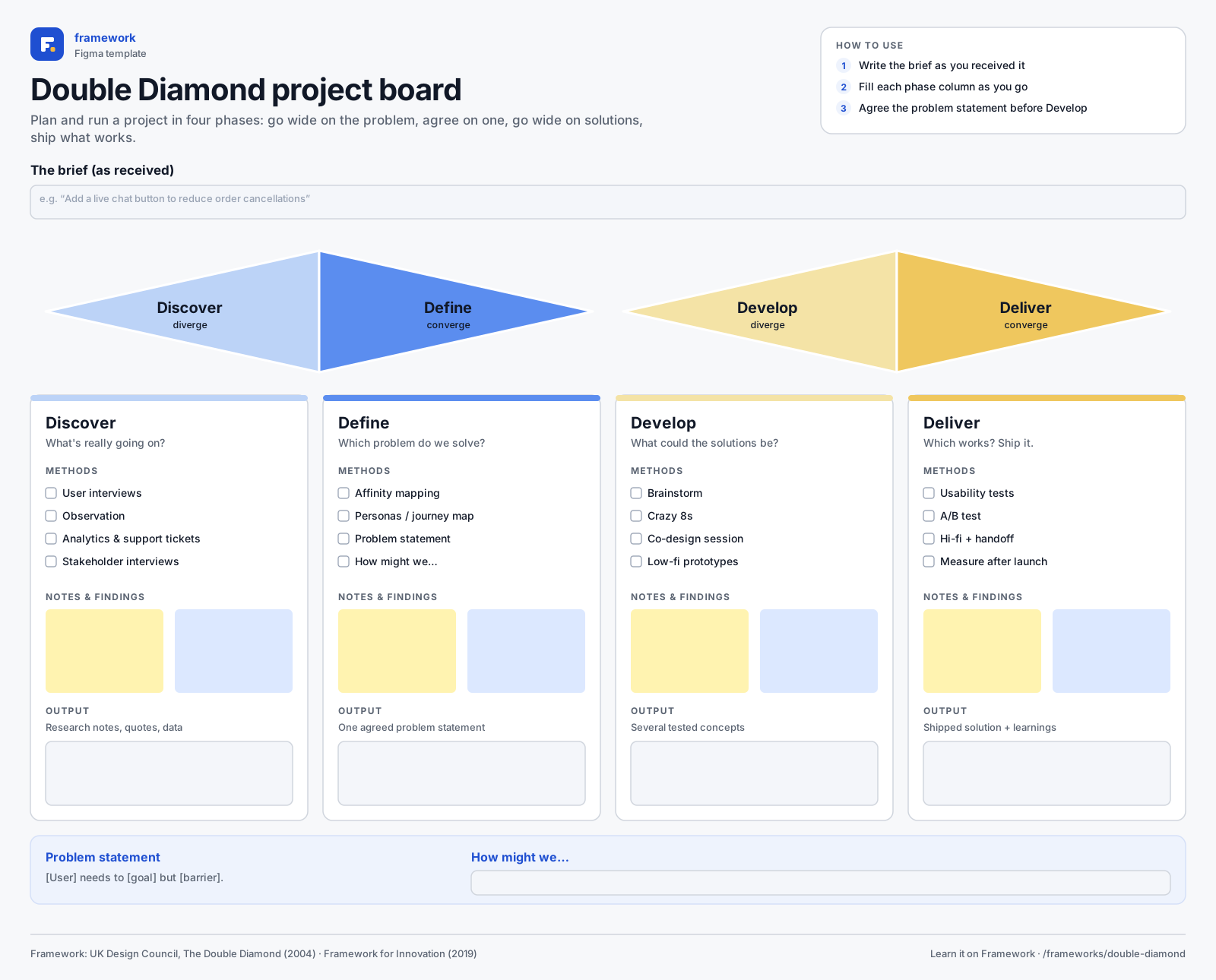
Double Diamond project board
- Four phase columns
- Method checklists
- Problem statement
- 1Download the SVG, or copy it to your clipboard.
- 2In Figma or FigJam, drag the file onto the canvas — or paste with ⌘V / Ctrl V.
- 3Everything arrives as editable layers: type in the boxes, add stickies, duplicate rows.
Quick quiz
Get all three right to complete the lesson.
Notes are private and stored in this browser.
Sources and further reading
Related frameworks
Jobs To Be Done
People don't buy products. They hire them to make progress in their lives.