Hooked Model
Trigger → Action → Variable reward → Investment: the loop behind habit-forming products.
Designing for repeat use and habits, responsibly.
A hook canvas for one habit, plus an ethics check.
Products that people use without being asked
Nir Eyal's book Hooked: How to Build Habit-Forming Products (2014) describes a four-step loop — Trigger → Action → Variable reward → Investment — that habit-forming products repeat until users come back on their own.
The goal is to move people from external triggers (a notification) to internal triggers (a feeling), so the product becomes the automatic answer to a need.
The four steps of a hook
Select a step to see what it means and a real example.
Trigger
What makes the user start?
The cue to act. External triggers are notifications, emails, buttons. Internal triggers are feelings — boredom, loneliness, uncertainty — that the user learns to connect with your product.
Example: External: “Riya tagged you in a photo.” Internal: feeling bored in a queue → open Instagram.
One loop in Instagram
Follow a single cycle from notification to posting.
External trigger
Action: open and scroll
Variable reward
Investment
Internal trigger forms
Illustrative walkthrough. Screens are simplified recreations, not real screenshots.
Hook canvas for your product
Fill in each step for one habit you want to build. The loop updates as you type.
8 PM “Hungry? Your usual is 1 tap away” notification
Later, internally: Hungry and tired after a long day at work
Open the app and tap Reorder
Today's offer, a new dish or a faster delivery time
Save favourites and address, rate the meal
↺ The investment should make the next trigger more likely.
The Manipulation Matrix
Eyal asks two questions before you build a habit: would you use it yourself, and does it materially improve users' lives?
Facilitator
Would use it themselves · improves users' lives
Peddler
Wouldn't use it · claims to improve lives
Entertainer
Would use it · doesn't really improve lives
Dealer
Wouldn't use it · doesn't improve lives
Aim for Facilitator. In money, lending and kids' products, the bar should be even higher.
Common mistakes
✓ Do
- Start from a real, frequent user need
- Make the action as easy as possible
- Let the investment improve the product for the user
- Aim to move from external to internal triggers
- Check yourself with the Manipulation Matrix
✗ Avoid
- Hooks for things people only do once a year
- Rewards that are random but worthless
- Notification spam as a substitute for value
- Investments that only benefit the company
- Building compulsion into products for vulnerable users
Hooked Model in one screen
THE LOOP
1 TRIGGER      external (notification, email, button) → internal (emotion)
2 ACTION       simplest behaviour in anticipation of reward  (B = MAP)
3 VARIABLE     tribe (social) · hunt (resources/info) · self (mastery)
  REWARD
4 INVESTMENT   content, data, followers, reputation, skill → loads next trigger

HABIT ZONE     frequent behaviour + perceived usefulness

MANIPULATION MATRIX
                 improves lives   doesn't
  I'd use it     Facilitator      Entertainer
I wouldn't Peddler DealerFigma template
A ready-made canvas for running this framework with your team. Free, editable, and it works in Figma and FigJam.
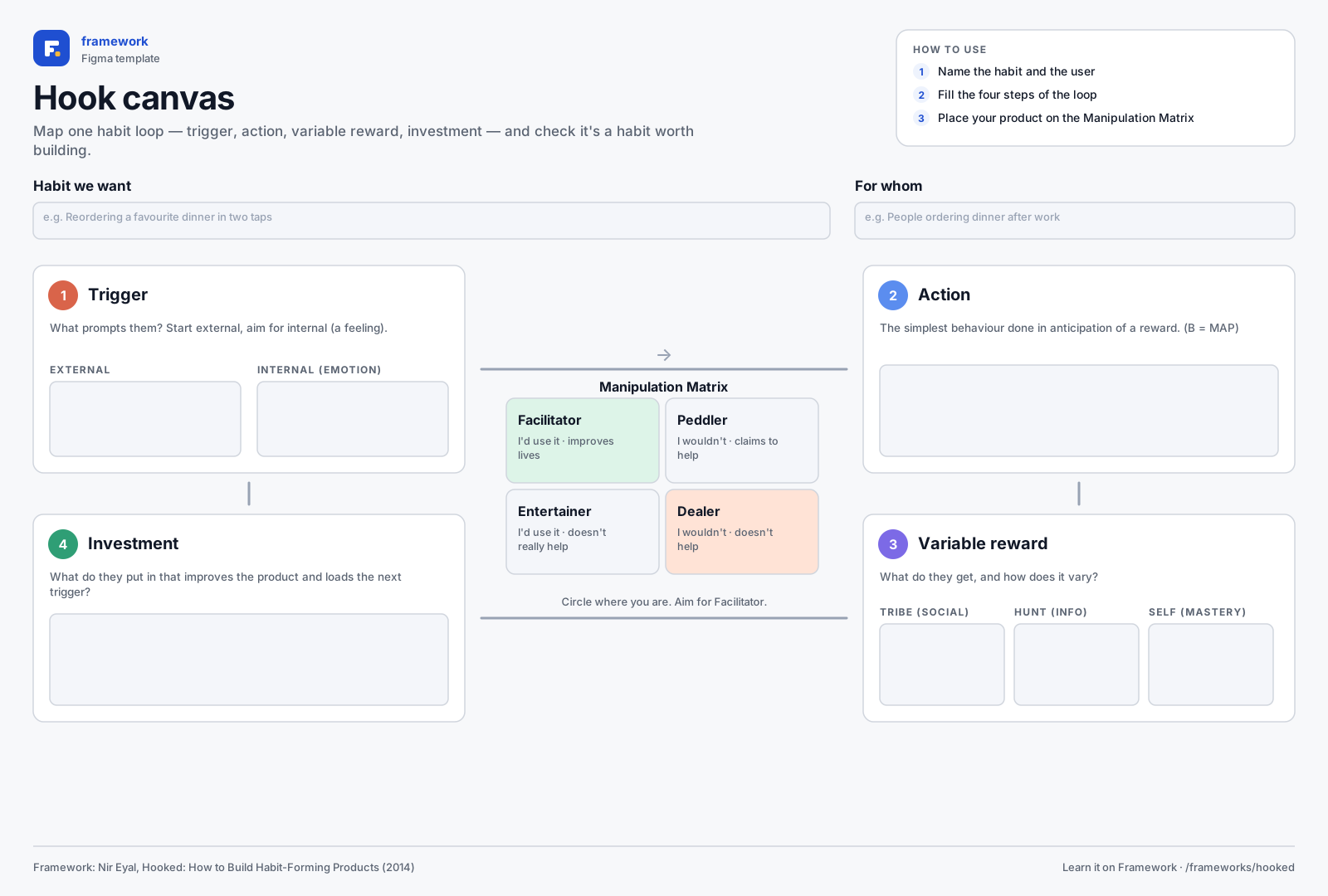
Hook canvas
- Trigger → Action → Reward → Investment loop
- Variable reward types
- Manipulation Matrix
- 1Download the SVG, or copy it to your clipboard.
- 2In Figma or FigJam, drag the file onto the canvas — or paste with ⌘V / Ctrl V.
- 3Everything arrives as editable layers: type in the boxes, add stickies, duplicate rows.
Quick quiz
Get all three right to complete the lesson.
Notes are private and stored in this browser.
Sources and further reading
- Nir Eyal — Hooked: How to Build Habit-Forming Products (2014)
- Nir Eyal — nirandfar.com
Related frameworks
COM-B
Behaviour needs Capability, Opportunity and Motivation. Widely used in public-health programmes.